
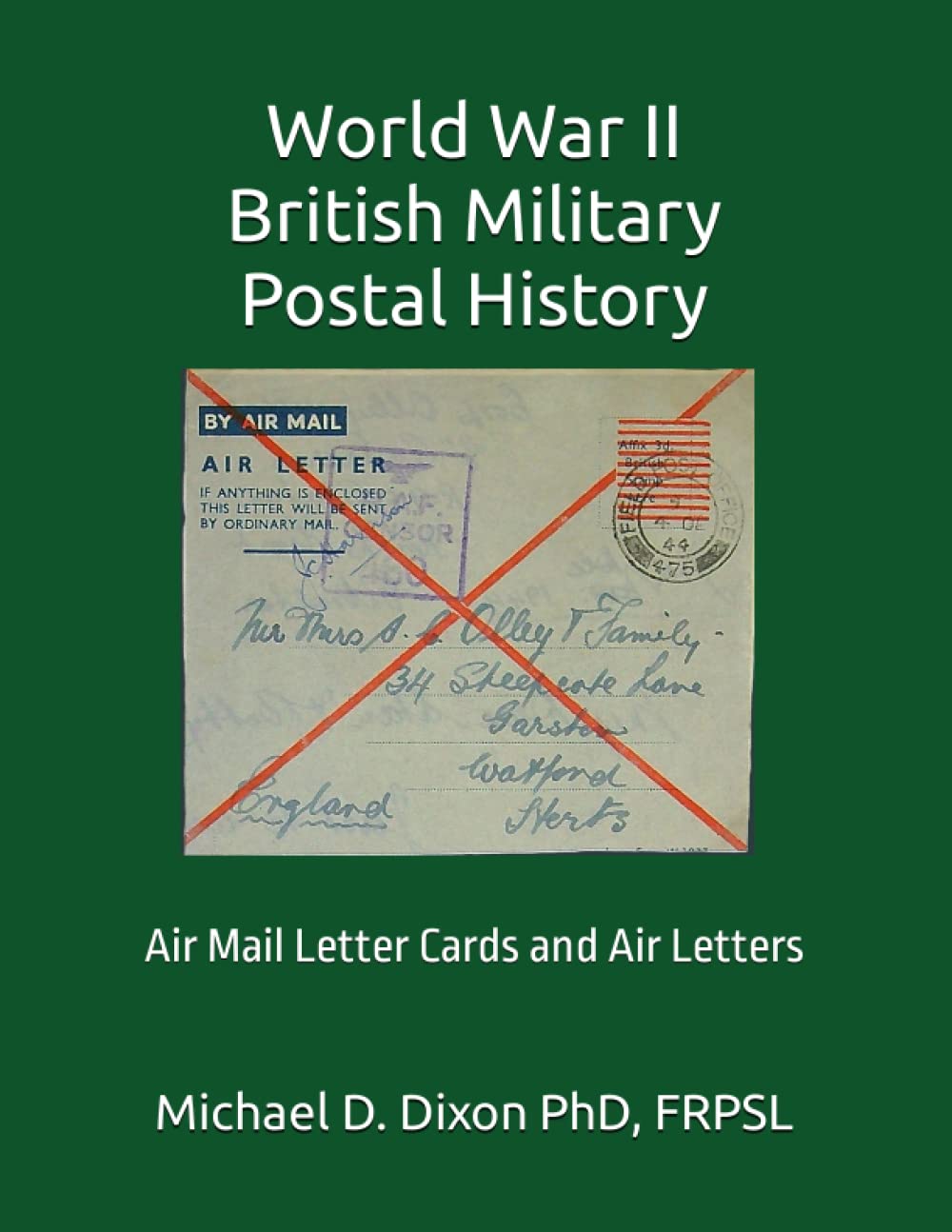
World War II British Military Postal History: Air Mail Letter Cards and Air Letters
Product details
| Management number | 233448546 | Release Date | 2026/06/27 | List Price | US$13.79 | Model Number | 233448546 | ||
|---|---|---|---|---|---|---|---|---|---|
| Category | |||||||||
This exhibit presents Great Britain Air Mail Letter Cards and “ Air Letters used from, to and between forces in different theaters of war and illustrates characteristics of British military postal history of World War II.Material is presented as it relates to the different regions, with the exception of sections for naval forces, civilian mail, and items not otherwise categorized Air Mail Letter Cards and Air Letters.The circumstances of War II, with the escalating need to efficiently convey massive quantities of mail to and from forces in the different theaters of war, led to the introduction by Great Britain in April 1941 of special airmail stationery and services for the forces. Britain introduced the Air Mail Letter Card (ALC) for British forces overseas for quick, inexpensive contact with home at a mailing rate of 3d. each compared with the normal airmail rate of 1s. 3d. per one-half oz. This was possible as the ALC comprised a single sheet of lightweight paper weighing only approximately 3.3 grams. The service was later extended to commonwealth forces and to forces of governments in exile serving with the Allies.The War Cabinet overseas mail committee, on 3 December 1943, invited service departments to discontinue using the term Air Mail Letter Card in favor of Air Letter in all connections in which the former term had been used. To economize on production and transportation costs, forms were printed locally, giving rise to many variants of the basic approved design.At monthly pay parades, each enlisted man was issued with free forms of standard basic design, so-called formula Air Letter Cards or Air Letters, and allowed to mail a limited number free of charge. On 9 August 1941, the issue was rationed at one per man per fortnight, the cost was absorbed by the Defense authorities. A directive of 7 March 1944 instructed that from 15 March 1944, the ration of Air Letters was increased to three per two weeks per man, but was changed four days later to six per four weeks per man. On 28 July, this was further increased to two per week per man. Forces in most units were able to purchase additional Air Mail Letter Cards/Air Letters for mailing at their own expense.Examples are shown of Air Mail Letter Cards or Air Letters not issued free of charge when mailers had to apply the appropriate British adhesive stamps for pre-paid mail (3d. rate). Examples are shown from some areas where stamps of the local postal authority were permitted.As a rule, Forces correspondence was subject to military censorship. However, in the interest of keeping morale high, the authorities permitted one Air Mail Letter Card/Air Letter per week per man to be free from censorship at the unit level, although it remained subject to Base censorship. These so-called Privilege letters required a declaration by the forces of the nature of their content.On 21 July 1941, Great Britain became the first country in Europe to issue pre-stamped Air Letter sheets, i.e., with indicia. The first British issue for general worldwide use appeared in June 1943; these Air Letters were priced at 6d., inclusive of postage. Special Forces Air Letters issued in 1945.Key philatelic items, and those illustrating original research, are displayed on red mattes.This is the third of Michael Dixon's exhibits and his second WWII exhibit to be published by Exhibitors Press. Read more
| ASIN | B0BPSSYTQY |
|---|---|
| ISBN13 | 979-8367688436 |
| Language | English |
| Publisher | Independently published |
| Dimensions | 8.5 x 0.4 x 11 inches |
| Item Weight | 1.11 pounds |
| Print length | 168 pages |
| Publication date | December 12, 2022 |
Bestseller ranking
Public Relations


Customers who viewed this product also viewed
Great Britain



Correction of product information
If you notice any omissions or errors in the product information on this page, please use the correction request form below.
Correction Request Form